
FUSED DEPOSITION MODELING (FDM)
FAST AFFORDABLE PROTOTYPE AND PART
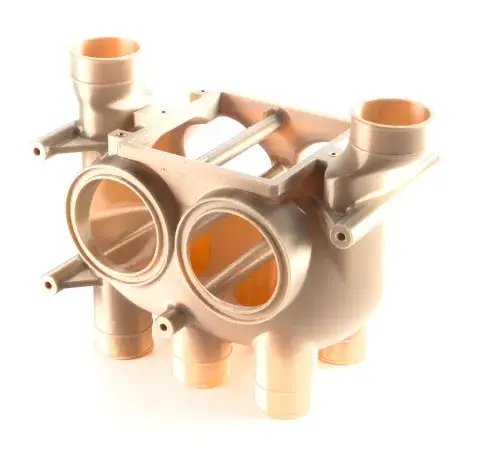
LARGE SIZES- TECHNICAL SPECIFICATIONS
Fused Deposition Modelling technology is one of our areas of expertise and we manufacture in two sizes:
| Minimum wall thickness | 0,5 – 1 mm |
| Minimum detail to be reproduced | 0.3 mm |
| Accuracy | 0.1% (min +/- 0,2) |
| Maximum part size | 400 * 400 * 400 mm |
| Layer thickness | 0,020-0,080 mm |

MATERIALS
FDM works by extruding heated thermoplastica material layer-by-layer onto a build tray.

ABS
-
- Tensile Modulus 1920MPa
- Impact Toughness
- HDT 86ºC

ASA
-
- YieldTensile Strenght 33MPa
- Tensile Modulus
- HDT 102ºC
- Mechanical properties

PC
-
- IZOD IMPACT
- HDT 144ºC
- Flexural strenght
75MPa - Tensile Strenght 58MPa
PC-ABS
-
- IZOD IMPACT
- HDT 125ºC
- Flexural strenght
746,2MPa - Tensile Strenght 36MPa

PC-ISO
-
- ITensile Strenght 57MPa
- Tensile Modulus
200MPa - HDT 144ºC
- IZOD IMPACT 86J/m

ULTEM 9085
-
- Ultimate Tensile Strenght 69MPa
- HDT 153ºC

ULTEM 1010
-
- Tensile Strenght, Yield 215ºC
- Tensile Modulus 3 Gpa
- HDT 215ºC
- IZOD IMPACT 25J/m

PPSF
-
- Tensile Strenght 55MPa
- Tensile Modulus
2100MPa - HDT 189ºC
- IZOD IMPACT 58,7J/m
NYLON12
-
- Tensile Strength 50MPa
- Tensile Modulus 1,5GPa
- HDT 95ºC
- IZOD Impact 140J/M
NYLON12 CF
-
- Tensile Strength
- HDT 154ºC
- Tensile Modulus 9,5GPa
- IZOD impact 105J/m

ANTERO (PEKK)
-
- Yield Tensile Strength
90MPa - Tensile Modulus 2,9GPa
- HDT 150ºC
- Notched impact 45J/m
- Yield Tensile Strength
FDM PROCESS
Layer by layer deposition of fused thermoplastic materials. The best technology for the production of final parts and industrial prototyping.
1
Validation
Together with the customer, the technical team verifies the manufacturability of the part in order to subsequently validate it.
2
Production
Machinery and staff work together for an optimal production.
3
Post-processing
The removal of the support material, which can break or dissolve, is a fundamental step in FDM technology.
4
Dimensional control
The part is measured at the end of the process, ensuring that the final result meets the customer’s specifications.
ADVANTAGES OF FDM TECHNOLOGY

Wide range of materials

Fast and cost-effective production

Parts up to
900 x 600 x 900 mm

Lighter part cores: weight reduction

Materials with excellent mechanical properties
Applications
FDM works by extruding heated thermoplastic material layer by layer into a build tray.
Prototypes and functional parts
Tooling
Moulds for composite materials
Certified flight parts
Drilling templates
High temperature polymer applications

Interesting articles

What is Fused Deposition Modelling?
Everything you need to know about FDM technology – Fused Deposition Modelling, from Mizar Additive Manufacturing.

The Powder Bed Fusion (PBF) additive manufacturing process
This article will tell you about the Powder Bed Fusion (PBF) process. It is an advanced additive manufacturing process that uses a high energy source, lasers or electrons.

7 Families of Additive Manufacturing
Additive manufacturing is gaining momentum as a process capable of manufacturing highly complex components quickly and directly. In previous articles, we have already mentioned some advantages and applications of additive manufacturing and we have also explained how...