
Additive manufacturing (AF) is the manufacturing method that has made it possible, more than any other method, to create products of high functional efficiency and great lightness, both essential aspects for the aerospace sector. In addition, the aerospace industry is focused on the low volume production of systems with complex mechanical and electronic components, and additive manufacturing responds very well to these demands.
Up to the requirements
The aerospace industry directs much of its efforts to developing products that are subjected to extremely high demands. In other words, it needs to develop more efficient products with minimised weight and high structural and functional demands. These are the aspects on which FA is based to provide competitive advantages over other conventional methods.
Indeed the Spanish Aerospace Platform has identified this technology as one of the priorities to be developed within the Spanish R&D&I strategy for the sector. Additive manufacturing thus has great potential to become an established manufacturing process in the industry. Additive manufacturing thus has great potential to become an established manufacturing process in the industry.
PBF and FDM, the leading technologies
For the moment, the effort has been focused on the development of secondary structural elements by PBF (Powder Bed Fusion) technology, as well as the fabrication of support structures and tooling with polymeric materials by FDM (Fused Deposition Modelling) technology.
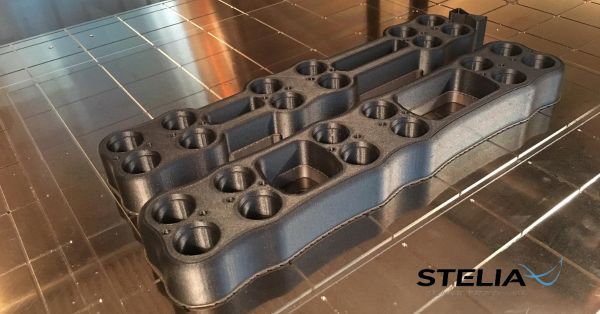
The Differentiators
The following differentiators of additive manufacturing are being instrumental in its full development in the space sector:
- The space industry is in constant development and requires very short production runs. This facilitates the constant adaptation of additive technology to the needs of the space industry. This facilitates the constant adaptation of additive technology to the needs of the space industry.
- The non-recurring cost for the space industry has a big impact on the final price of the component (very short series In AM processes, the use of tooling is minimized, so the technology has an additional advantage.
- A piece-by-piece qualification process is used in space. This represents a great advantage against the certification requirements needed.
Heavyweight Advantages
FEWER PARTS AND GREATER COMPLEXITY
When conceiving a product, the limitations of mass production processes are a determining factor for designers. There are designs that involve complex topologies and therefore their manufacture requires the creation of several smaller parts as a preliminary step. Herein lies one of the great and important advantages of additive manufacturing over subtractive manufacturing: the geometry of the parts is not limiting however complex it may be. Therefore, additive manufacturing reduces the number of parts required and allows optimized designs. Therefore, additive manufacturing reduces the number of parts required and allows optimized designs.
What are the implications for the aerospace industry? The additive manufacturing of mechanical components with complex geometries has meant manufacturing fewer parts and therefore a reduction in the total weight of these parts. The direct consequence of this would be to reduce the weight of the aircraft, which reduces fuel consumption.
Electronic components that can be manufactured using AF include sensor arrays, antennas and RF amplifiers or multilayer cable assemblies. In short, pieces have unique functionality and shape.
EASIER WORK AND LESS WASTE
Many aerospace applications require the use of exotic metals that are difficult to work and machine through traditional processes. The fact that these materials are beginning to be incorporated into additive manufacturing systems substantially expands the area of influence of additive manufacturing in aerospace.
Another fundamentally differentiating aspect of additive manufacturing lies in the reduction of waste due to its additive nature. This means that only the required material is used in the production process, whereas subtractive manufacturing removes (subtracts) the excess material to obtain the product.
RAPID REPLACEMENT OF COMPLEX PARTS
Aircraft maintenance (including replacement of mechanical and electronic components) is an area where additive manufacturing has a lot to say. What happens with some electronic and mechanical components (the more complex ones) is that they are not always in inventory and must be replaced periodically. The lead times of a traditional manufacturer for this type of part can be weeks or months.
Additive manufacturing allows mechanical or electronic parts to be produced on-demand, eliminating the need to keep certain types of parts in inventory. AM allows individual spare parts to be manufactured and shipped to the customer immediately, thus reducing delivery times.
This characteristic makes us think of a future in which the AM of electronic components will be used for lean manufacturing.
COST CONTROL
As we have seen, additive manufacturing systems require fewer parts, fewer fixtures, and fewer assembly steps, so they can be produced faster and at a lower cost.
There are two main factors that will drive down the cost of developing and manufacturing electronics for aerospace systems: the reduced level of manufacturing complexity and the accelerated prototyping process.
Conclusion
The aerospace industry has employed additive manufacturing (AM) for a wide range of products such as parts for airplanes and helicopters, or engines and turbines. Because the truth is that AM has improved the performance of the parts, reduced their weight, and helped eliminate design and production constraints.
Until recently, additive manufacturing has been limited mainly to non-critical parts, such as ductwork or interior components. However, it is beginning to play a more significant role in the production of aircraft for first-class manufacturers. However, it is beginning to play a more significant role in the production of aircraft for first-class manufacturers.
At Mizar, we are committed to continuing innovating for the aerospace sector and we are at our customers’ disposal for any type of consultation.
