
ELECTRON BEAM MELTING (EBM)

The process of creating the part is carried out in a vacuum working chamber at a temperature of approximately 700-900ᵒC.
Thanks to this, the parts created during the process have no internal stresses and the properties obtained are superior to those that can be obtained in a foundry.
TECHNICAL SPECIFICATIONS
| Minimum wall thickness | 1 mm |
| Minimal detail to be reproduced | 0,6 mm |
| Precision | 0,3% (min +/- 0,25) |
| Maximum part size | 210 * 210 * 210 mm |
| Layer thickness | 0,050 mm |
CUSTOMISE YOUR PIECES
If you wish to include customised texts in your EBM pieces, please follow our recommendations.
If the text is to be engraved internally, higher print parameters must be set.

Embossed text
hmin 0,8 mm emin 0,5 mm Hmin 0,8 mm

Engraved text
hmin 1 ,6 mm emin 1,2 mm Hmin 4,5 mm
SUPPORT OPTIMISATION
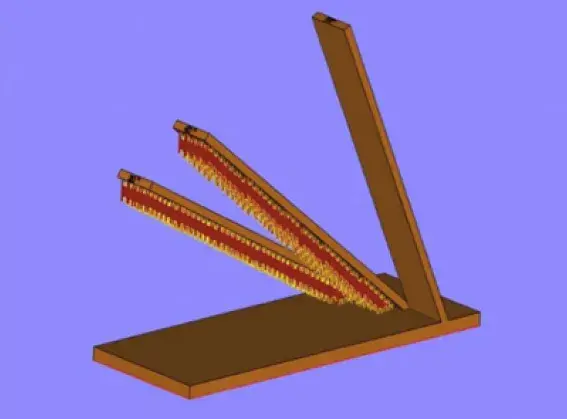
In the Direct Metal Laser Sintering technology it is necessary to build supports that help sustain the piece and transmit the heat provided to the base. The technical team of the project will be in charge of removing them.

Interesting articles

What is Fused Deposition Modelling?
Everything you need to know about FDM technology – Fused Deposition Modelling, from Mizar Additive Manufacturing.

The Powder Bed Fusion (PBF) additive manufacturing process
This article will tell you about the Powder Bed Fusion (PBF) process. It is an advanced additive manufacturing process that uses a high energy source, lasers or electrons.

DIFFERENCES BETWEEN ADDITIVE MANUFACTURING AND 3D PRINTING
In this article we explain the real differences between additive manufacturing and 3D printing.